

The number one misconception that dog owners have when it comes to training their dog is that canines learn the same way we learn. That is not true. Dogs do not think or learn the same way humans do. It is important to help your client understand that:
Dogs are not human.
Dogs are a different species
They act and think differently
Dogs use their eyes and nose to learn (social learning). They learn a lot of information about other dogs just by smelling butts. They also pick up on our mood by observing our body language. Their senses help them learn. As a matter of fact, dogs learn hand signals quicker than verbal commands, which is why most trainers use sign language in their training.
In addition to social learning, dogs learn through behavioural conditional methods discovered through extensive studies performed by Russian Psychologists Pavlov and B.F. Skinner. Their methods, known as classical and operant conditioning, are still used to train dogs today.
What is Classical Conditioning (Pavlovian conditioning)?A process that occurs when two stimuli are repeatedly paired. The cartoon below demonstrates how classical conditioning teaches dogs to associate things (photo credit: very well).
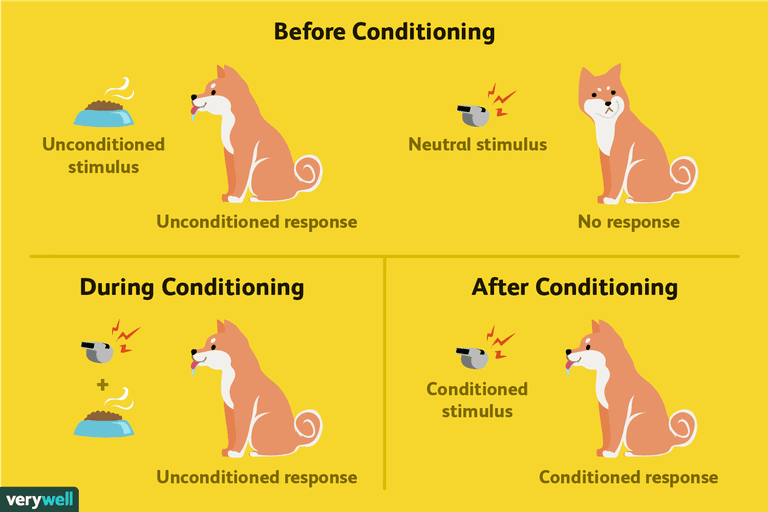
Basically, classical conditioning helps dogs predict what is about to happen. Example: grabbing a leash means they are going for a walk (makes dogs happy). Opening a particular cabinet means treat time (makes dogs happy). The jingling of keys means the humans are leaving (makes some dogs sad or anxious). The sound of a coffee pot signifies that it is a work day for humans (causing sadness or anxiety)
Classical conditioning can help dogs overcome fear (providing treats while grooming), but it can also cause fear (car rides always end in vet visits).
Animals, like people, must learn that consequence matters, which brings us to Operant Conditioning (a theory of Psychologist B.F. Skinner). This theory teaches us that a behavior can be changed by adding or taking a stimulus away from the dog. A stimulus can be food or toy rewards. It can also be an unpleasant sound or leash/collar correction. See the cartoon below for an example. (Photo credit: very well)
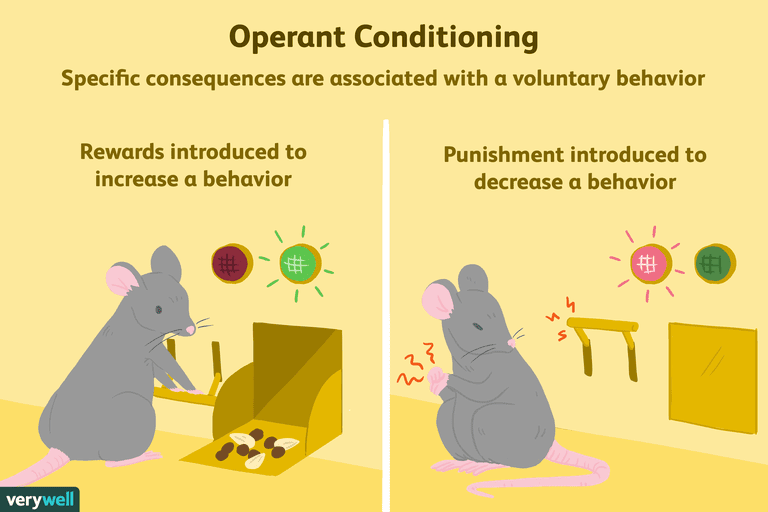
The principal behind operant conditioning is that a behavior positively reinforced will reoccur. A behavior negatively reinforced will lessen.
Discover how dogs learn through different forms of conditioning, including the stages of learning with ISCDT’s online or in-person programs.

ISCDT offers an 18-lesson course for those wishing to train dogs professionally. In Lesson One students learn about Classical and Operant Conditioning. The course delves deeper into canine behavior, how they learn and how we can communicate with this wonderful species. The course is offered online, which allows you to learn anywhere, and in person. Students evidence understanding of each lesson through written and video assignments. Students must have access to a dog(s) throughout this learning process in order for them to translate written work to hands-on training.
Katie McKnight
 ISCDT - The Dog Trainer's School